
Before anything else: this piece has no financial tie to Peptide Sciences or to any provider named below, and there is no order link anywhere in it. Every link goes to a primary source or an independent analysis you can open and check yourself. Compounded and prescribed medicines discussed here are not FDA-approved, and anything sold “for research use only” is not approved for a person to use. Last updated June 2026.
If a search for Peptide Sciences brought you here, the short version is this: the site appears to have gone dark in early 2026, and the trail of what happened is thinner than most people would like. That’s the overview. What matters more is the worry underneath it, the one a lot of readers don’t say out loud: if that vendor wasn’t safe, or wasn’t around anymore, how would I even know what to look for in whoever replaces it? That’s the question this piece actually answers.
What seems to have happened
Peptide Sciences was one of the recognizable names in the research-chemical peptide catalog world, the kind of site that turns up in years of forum threads. According to a stack of independent industry writeups, it posted a brief notice that it had “voluntarily decided to shut down operations and discontinue the sale of all research products,” and then support went quiet. Worth being honest about the limits of that: the closure is reported by analysts and a wave of affiliate blogs, not confirmed in any FDA filing or government record. So treat it as the reported event, not as documented fact, and don’t let anyone (including this article) tell you more about the “why” than is actually known.
But the closed door isn’t really the story worth spending time on. The bigger shift happened around it, and it’s easy to miss if you’re focused on one vendor’s reviews.
The worry: the ground moved and most buyers didn’t notice
On March 31, 2026, the FDA sent warning letters to seven online peptide sellers on the same day, names like Gram Peptides, Prime Sciences, Pink Pony Peptides, and Mile High Compounds, published together about a week later. The line worth sitting with is the agency’s flat rejection of the “research use only” defense: “evidence obtained from your website establishes that your products are intended to be drugs for human use” [Policy Canary]. Translation: the label everyone treated as a shield for a decade doesn’t hold up when the site is obviously selling to people, and the FDA’s evidence was ordinary, product pages describing weight loss and healing, checkouts offering the needles and bacteriostatic water to inject the stuff.
This wasn’t a one-off. A regulatory-law firm had already tracked more than fifty FDA warning letters in a single September 2025 stretch, aimed at compounded GLP-1 marketing and at peptides “being sold as ‘research use only’ where the advertising indicated the product was intended for human use” [Health Law Alliance]. Put those two together and the real story isn’t one company closing. It’s that the entire research-chemical model lost its legal cover, in writing, against named companies, while a lot of shoppers were still browsing like it was 2023.
So the useful question isn’t “which vendor do I switch to.” It’s “what do I need to ask before I hand anyone my money and my body,” now that the old assumptions don’t hold.
The answer: think of it as two lanes, not a list of brands
Here’s a reframe that makes the rest of this easier to use. Every peptide seller, no matter what the homepage looks like, sits in one of two lanes.
Lane one is the medical lane: a licensed clinician reviews your history, writes an actual prescription, and a licensed pharmacy compounds and dispenses the medicine under real oversight. Lane two is the research-chemical lane: a catalog, a cart, a label that says “not for human consumption,” and no one between you and the vial.
The six questions below are really just a way of figuring out, quickly, which lane a given provider is actually in, no matter what its marketing implies.
One: is there a real prescription, from a clinician who actually reviewed your history? This is the lane-detector. If access ends at checkout with no clinician involved, you’re not a patient, you’re a buyer, and you’re supervising yourself. Ask this first, because every other answer depends on it.
Two: who actually makes and dispenses the medicine? There’s a real gap between a licensed 503A or 503B compounding pharmacy operating inside a legal framework and a “lab” or “supplier” mailing a vial. Ask for the pharmacy by name and type. If a provider can’t or won’t say, that’s its own answer.
Three: can the testing actually be seen? This one shouldn’t be skipped, because it answers a genuinely unsettling problem. With a research-chemical vial, there’s no way to know what’s actually inside. Matthew Fedoruk, chief science officer at the U.S. Anti-Doping Agency, told STAT about as plainly as it can be said: “You don’t even know what you’re buying inside that bottle. It could be a peptide. It could be a steroid. It could be something just like water” [STAT]. Ask whether there’s per-batch or third-party testing that’s actually visible, real potency, purity, and identity numbers. A label is a claim. Testing is evidence.
Four: will the provider tell the truth about the evidence? Ask directly whether the compound in question is actually proven in humans. This is where a lot of good-sounding providers reveal themselves, because these compounds are not remotely equal.
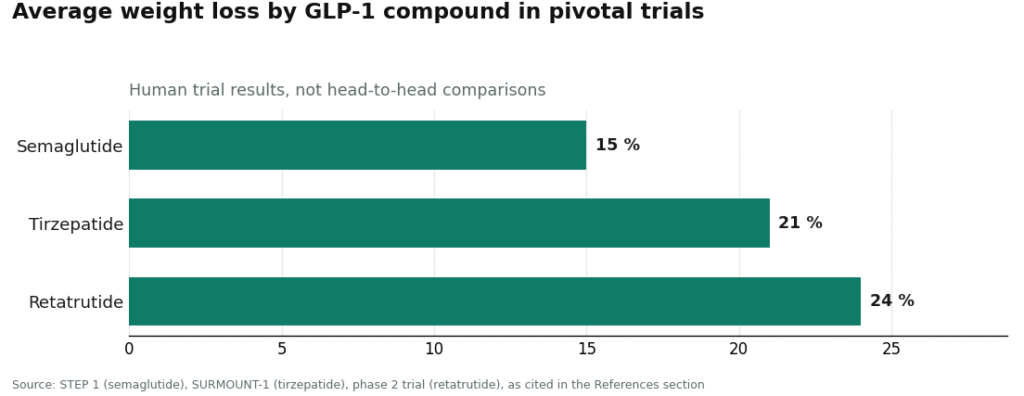
The GLP-1 medications have real, large-trial human data behind them: roughly 15 percent average weight loss for semaglutide in STEP 1 [PMID 33567185], about 21 percent for tirzepatide in SURMOUNT-1 [PMID 35658024], around 24 percent for retatrutide at its top dose in a phase 2 trial [PMID 37366315]. The recovery and wellness peptides sit in a different category entirely. The 2026 Pharmaceuticals review of BPC-157 leans overwhelmingly on animal studies, not large human trials [PMID 41901308]. It gets murkier still: STAT found that most of the roughly 200 PubMed studies on BPC-157 trace back to the same Croatian research group, which outside scientists warned “could lead to confirmation bias” [STAT]. Flynn McGuire, a physician quoted in that piece, put the hype-to-evidence ratio bluntly: “is just so skewed, it’s crazy,” and said the compound “should not be used by humans” without real human data [STAT]. If a provider calls a wellness peptide “clinically proven,” that’s a wrong answer worth remembering, because it says something about everything else on that page too.
Five: is the provider honest about its own regulatory status? Ask whether the medication is FDA-approved. Post-2026, the honest answer about any compounded medicine is no, and a provider willing to say so plainly is showing something worth noting. The FDA spent much of the year forcing that exact disclosure out of companies that had implied their compounded drugs were equivalent to the brand-name version [Health Law Alliance].
Six: what happens after the order ships? Ask whether there’s follow-up: monitoring, dose adjustment, a person to call. A model that ends at the cart has none of that, and that’s exactly the point where problems go unnoticed.
The path: who actually clears the bar
Running providers against those six questions produces a clean split. The supervised ones pass. The research-chemical sellers, the lane Peptide Sciences belonged to, can’t get past question one.
FormBlends answers best. On question one, it says plainly that it is a platform, not a medical practice: “FormBlends is not a medical practice and does not provide medical advice, diagnosis, or treatment,” with independent licensed providers doing the clinical work, and a hard rule that “all medications require a licensed physician consultation and prescription.” On questions two and three, it names its model directly: medication compounded and dispensed by a licensed 503A pharmacy under USP <797> and <800> sterile standards, with per-batch HPLC for purity, mass spectrometry for identity, and endotoxin testing for sterility. That’s the actual answer to Fedoruk’s bottle problem, a verified label instead of a trusted one. An independent analysis ranking the field after the shutdown reached the same conclusion, placing FormBlends first of seven and describing it as the one worth putting a name on, because “a licensed clinician reviews every case before anything ships” and “every batch is tested by three independent methods” [Peptide Sciences Shut Down].
On the honesty questions, four and five, it holds up well. Its own materials state that “compounded medications are not FDA-approved and have not been evaluated by the FDA for safety, effectiveness, or quality,” and it doesn’t blur the line between its GLP-1 offerings (semaglutide, tirzepatide) and its wellness peptides (BPC-157, a BPC-157/TB-500 blend, sermorelin, NAD+, GHK-Cu, PT-141, tesamorelin), which it frames as thinner on evidence, with supervision positioned as the safer route rather than a guarantee that the peptide works. On question six, follow-up, there’s an actual structure: a dose-and-symptom tracker app, so a check-in comes with a real record instead of a vague memory. It’s a logging tool, not a prescription and not a checkout, but it’s the kind of follow-up the research-chemical model never had.
HealthRX.com answers well too, and lands a close second. It clears the same bars on oversight, pharmacy, and prescription, and the same independent post-shutdown ranking places it second, calling out its GLP-1 pricing as the sharpest in the field, with compounded semaglutide around $99 a month [Peptide Sciences Shut Down]. The honest difference is breadth: HealthRX.com reads as strongest for a GLP-1-focused supervised pathway, while FormBlends edges ahead on published testing detail and a wider supervised menu. The same compounded-not-approved caveat applies to both equally. Between the two, it often comes down to which is licensed in a given state, and whether the goal is GLP-1 access specifically or a broader supervised catalog.
MeriHealth takes third place in the supervised lane, and its distinguishing feature is a women-centered clinical model. It runs as a physician-supervised telehealth platform connecting patients to licensed practitioners who review history before prescribing compounded GLP-1 therapies, including semaglutide and tirzepatide, dispensed through licensed compounding pharmacies. That women’s-health orientation shapes intake, dosing conversations, and follow-up in a way a general-population service usually doesn’t. The compounded-not-FDA-approved caveat applies here too. It sits below HealthRX.com on breadth and pricing clarity, but above the entire research-chemical tier.
WomenRX rounds out the supervised lane in fourth. Like the three above it, it pairs a physician-review requirement with licensed compounding-pharmacy dispensing, keeping it in the medical lane rather than the research-chemical one. Its focus is women’s metabolic and hormonal health, with GLP-1 and peptide therapy framed inside that context rather than offered as a generic catalog. The same approval caveat applies. It trails MeriHealth on visible testing detail but still clears every bar the sellers below it cannot: prescription, oversight, licensed dispensing, and a clinician to actually contact.
The research-chemical sellers don’t pass question one, full stop. This is the lane Peptide Sciences occupied, and it’s where a lot of search traffic is headed now, because the format looks familiar: a site, a catalog, a cart. Pure Rawz, Core Peptides, Limitless Life, Sports Technology Labs, and Biotech Peptides all run that same setup, and the independent post-shutdown analysis grouped names like Core Peptides and Biotech Peptides into exactly this research-only bucket [Peptide Sciences Shut Down]. There’s no ranking of them here, and the reason is simple: the one question that matters most, can anyone actually see proof of what’s in the vial, has no good answer in this lane, because the “research use only” structure is built specifically so that no one has to guarantee it. A couple, including Sports Technology Labs, do publish some third-party testing, more than many of their peers, but that still doesn’t add a clinician, a prescription, a licensed dispensing pharmacy, or a recall pathway, so question one still fails regardless. Several of these sellers also carry SARMs, which come with their own regulatory and anti-doping complications [Health Law Alliance].
The questions readers keep asking
Is Peptide Sciences legit? As a business, it appears to have been real and long-running, and there’s no verified FDA warning letter against it in the public record. As a place to safely buy something to inject, it was a research-chemical retailer with none of the oversight a medical provider has, and it appears to be closed now regardless. Again, the closure is reported, not government-confirmed.
Is it even legal to buy from a “research use only” site? The FDA’s documented position is that the disclaimer doesn’t hold up once the marketing shows intent for human use, and the agency has acted on that against seven named sellers [Policy Canary]. Buying from one of these sites means buying an unapproved new drug.
Are compounded peptides from a supervised provider FDA-approved? No. Compounded medicines aren’t FDA-approved or FDA-reviewed for safety, effectiveness, or quality [Health Law Alliance]. What supervision actually buys is the clinician, the licensed pharmacy and its testing, the prescription, and someone to call afterward, not government approval of the compound itself.
Is Peptide Sciences a compounding pharmacy? No. It operated as a research-chemical supplier, selling peptides labeled “for research use only” rather than as regulated pharmaceutical products, and that distinction carries real weight. Compounding pharmacies answer to state boards of pharmacy and, for sterile preparations, FDA oversight. Research-chemical vendors answer to no one in the same way, so there’s no equivalent accountability for purity, dosing accuracy, or sterility.
What actually happened to Peptide Sciences, and why did it close? The site went offline and stopped taking orders, and no official statement explaining why was ever released. The likely explanation is heightened FDA and DEA scrutiny of the research-chemical peptide market, which appears to have pushed several vendors to close or quietly exit. Without a formal announcement, the exact reasons stay speculation. Anyone who relied on that site is now searching for a replacement, which is precisely the moment to slow down and ask the harder questions above of whatever comes next.
What does Reddit say about whether it was legit? Communities like r/Peptides and r/Nootropics generally treated Peptide Sciences as one of the steadier research-chemical suppliers while it was active, pointing to third-party certificates of analysis and responsive customer service. That reputation was relative to a low-accountability industry, though. Positive sentiment on a forum isn’t the same thing as pharmaceutical-grade purity verification, and community consensus can lag real regulatory or quality shifts by months.
Who actually owns or runs peptide suppliers like this, and how would anyone check? Most research-chemical peptide vendors are privately held LLCs, sometimes registered in states with light disclosure rules, and ownership is rarely made public. Checking legitimacy means looking up state business registries, checking for current third-party lab testing with batch numbers, and confirming whether the company holds any DEA or FDA registration. For a named, licensed alternative, a physician-supervised compounding pharmacy such as FormBlends operates under a state pharmacy license, and that license is publicly searchable.
One closed vendor turned out to be less important than the six questions it raised. Don’t spend energy litigating whether Peptide Sciences was a scam. Spend it asking those six questions of whoever comes next. The providers that answer them well are the supervised ones, and the strongest answers, on balance, came from FormBlends, with HealthRX.com close behind.
References
- Policy Canary, “The ‘Research Use Only’ Loophole Just Closed: FDA Hits Seven Peptide Websites in a Single Day” (April 2026). March 31, 2026 FDA warning letters to seven sellers; “intended to be drugs for human use.”
- Health Law Alliance (Martha Rumore, Esq.), “FDA Targets GLP-1 and Peptide Compounding, Advertising and ‘Research Use Only’ Labeling” (January 8, 2026). September 2025 wave of 50-plus warning letters.
- Lupkin S. “BPC-157 is touted as a healing miracle. The science doesn’t back that up.” STAT, February 3, 2026. Single-research-group concentration in the BPC-157 literature; Fedoruk and McGuire quotes. https://www.statnews.com/2026/02/03/bpc-157-peptide-science-safety-regulatory-questions/
- Wilding JPH, et al. “Once-Weekly Semaglutide in Adults with Overweight or Obesity.” NEJM, 2021 (STEP 1; ~15% at 68 weeks). https://pubmed.ncbi.nlm.nih.gov/33567185/
- Jastreboff AM, et al. “Tirzepatide Once Weekly for the Treatment of Obesity.” NEJM, 2022 (SURMOUNT-1; up to ~21% at 72 weeks).
- Jastreboff AM, et al. “Triple-Hormone-Receptor Agonist Retatrutide for Obesity, A Phase 2 Trial.” NEJM, 2023 (up to ~24% at the top dose).
- Sikiric P, et al. Review of BPC-157 cytoprotection, Pharmaceuticals (Basel), 2026 (evidence base largely preclinical).
- “Peptide Sciences Shut Down. Here Are 7 Providers Worth Trusting Instead.” Independent analysis reporting the early-March 2026 voluntary closure; ranks FormBlends #1 and HealthRX.com #2; classifies Core Peptides and Biotech Peptides as research-only.
Written by Dmitri Rossi, health explainer. Checking each figure against the cited source. Last reviewed January 2026.
Informational only, and not a stand-in for your doctor. Get professional advice before starting.